
Find People Across Muscogee Records
The best first record depends on what is known. A current street address points to the Board of Assessors, while a name tied to land belongs in the real estate index. A lawsuit, estate, divorce, or criminal matter belongs with the court that handled it. For an older Columbus resident, city directories and local newspaper indexes may work better than a current government portal.
Keep each match tied to a source and date. Muscogee County has many same-name residents, and an index entry is only a lead until a second official record supports it. The county and Columbus have shared a consolidated government since 1971, but the clerk, sheriff, probate court, tax offices, and elections office still keep their own records.
A phone number is less useful in local government indexes, so treat it as a way to confirm an address or name found elsewhere. For a former resident, begin with the last known year and place. Move one step at a time through directories, deeds, probate notices, and newspapers. This method keeps two people with the same name from blending into one false profile.
- Start with the newest fact: a full name, street address, parcel number, case number, or date.
- Use the assessor for an address or owner, then note the parcel and mailing address.
- Check deeds and court dockets under spelling variants, initials, former names, or entity names.
- Move to library indexes, directories, newspapers, probate files, and cemetery records for older trails.
- Ask the correct custodian for the file or copy when an online index gives only a reference.
Muscogee People Search Custodians
Three offices anchor a Muscogee County people search. The Superior and State Courts Clerk records land instruments and keeps its court divisions. The Board of Assessors links owner names with parcels and addresses. The City Attorney routes general Columbus Consolidated Government requests, although a direct request to the department that made a record is often faster. Full access rules and copy channels appear in the Muscogee County public records resource.
Real Estate Division
100 10th Street, second-floor tower
Columbus, GA 31901
706-653-4358
CCG Open Records
City Hall, 1111 First Avenue
Columbus, GA 31901
706-225-4025
Muscogee Assessor Search Modes
The Board of Assessors Public Access system gives five ways into the same property roll. Owner Search works from a name. Address Search reverses a street location to a parcel. Parcel Search accepts the tax identifier, Advanced Search combines criteria, and Map Search provides a spatial route. The data comes from the last certified tax roll, so it is a dated assessment source rather than live proof of who occupies a home.
The official owner-search screen shows the tabs and the disclaimer that must be accepted before results appear.
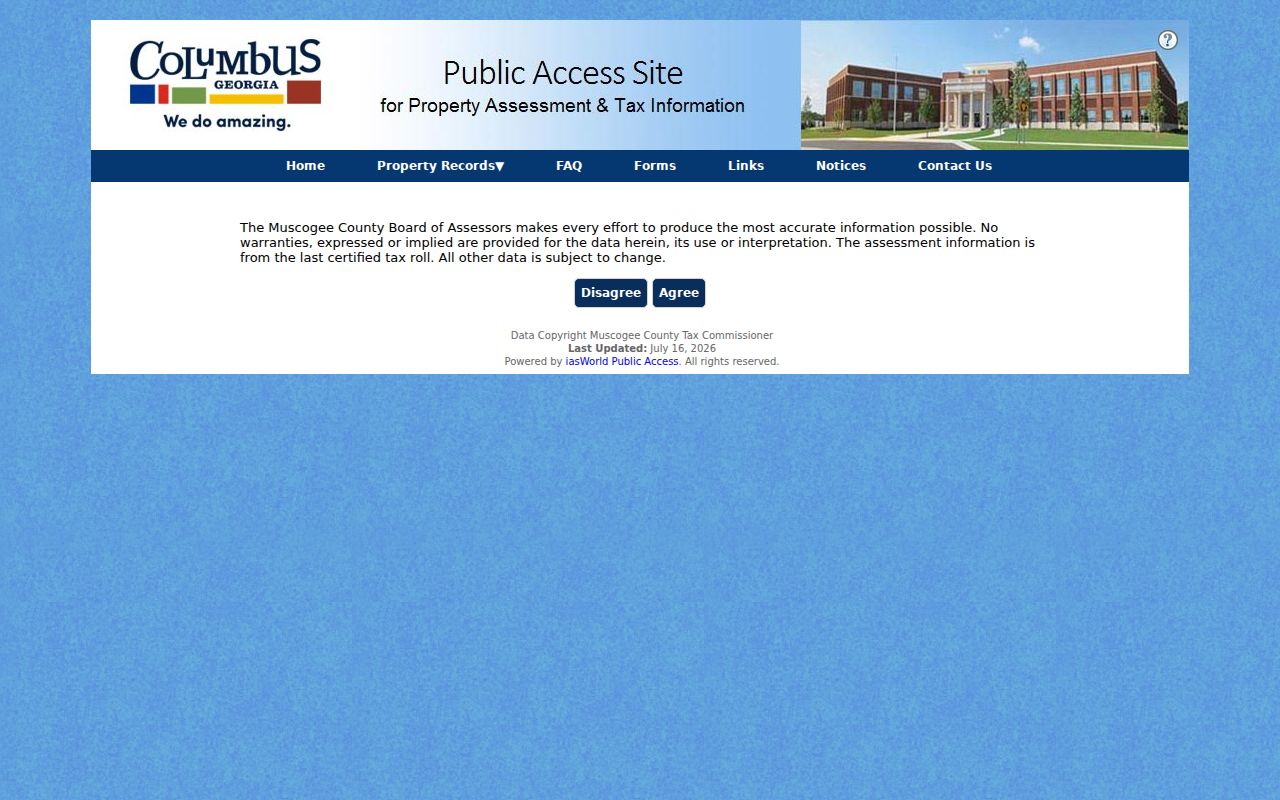
A useful parcel card may include the owner, mailing and situs addresses, parcel number, legal description, values, tax class, sale history, building facts, and a map link. The mailing address is where tax notices go; the situs is the property location. Neither field alone proves residence.
| Search route | Best known fact | Useful result |
|---|---|---|
| Owner | Person or entity name | Parcel and address candidates |
| Address | Street number and name | Current tax parcel |
| Parcel | Tax identifier | Parcel card |
| Advanced | Several property facts | Narrower candidate set |
| Map | Known place | Spatial parcel context |
Trace Muscogee Deed Names
A parcel result becomes a longer people trail through the Superior Court Clerk's recorded-land index. Start with the current vesting deed, record its book and page or instrument number, then search the grantee as a later grantor. Repeating that chain can reveal prior owners. Deeds may name grantors, grantees, legal descriptions, execution and recording dates, and return or preparer information. A security deed identifies borrower and lender relationships, but does not show who lives at the address.
EagleWeb name tools help when spelling is uncertain. The basic search accepts grantor, grantee, or combined party searches. A wildcard * can broaden a variant, while Advanced mode supports + for a required term and - for an excluded term. Search initials, hyphenated forms, former names, trusts, and business entities. The local page does not state the earliest online year, so the counter and mail copy form remain part of the trail.
- Grantor
- The party transferring an interest.
- Grantee
- The party receiving that interest.
- Index
- A finding tool that points to an instrument, not always its image.
- Plat
- A recorded map of lots, blocks, or boundaries.
Search Muscogee Court Parties
Muscogee Superior, State, Probate, and Recorder's courts hold different parts of a person's court trail. A public docket may show party names, case number, filing date, case type, status, events, counsel, and hearing data. It does not guarantee that pleadings or orders are online. Each court remains the custodian even when a shared electronic-access route helps locate the case.
Use the Georgia court electronic-access hub to identify the available route.
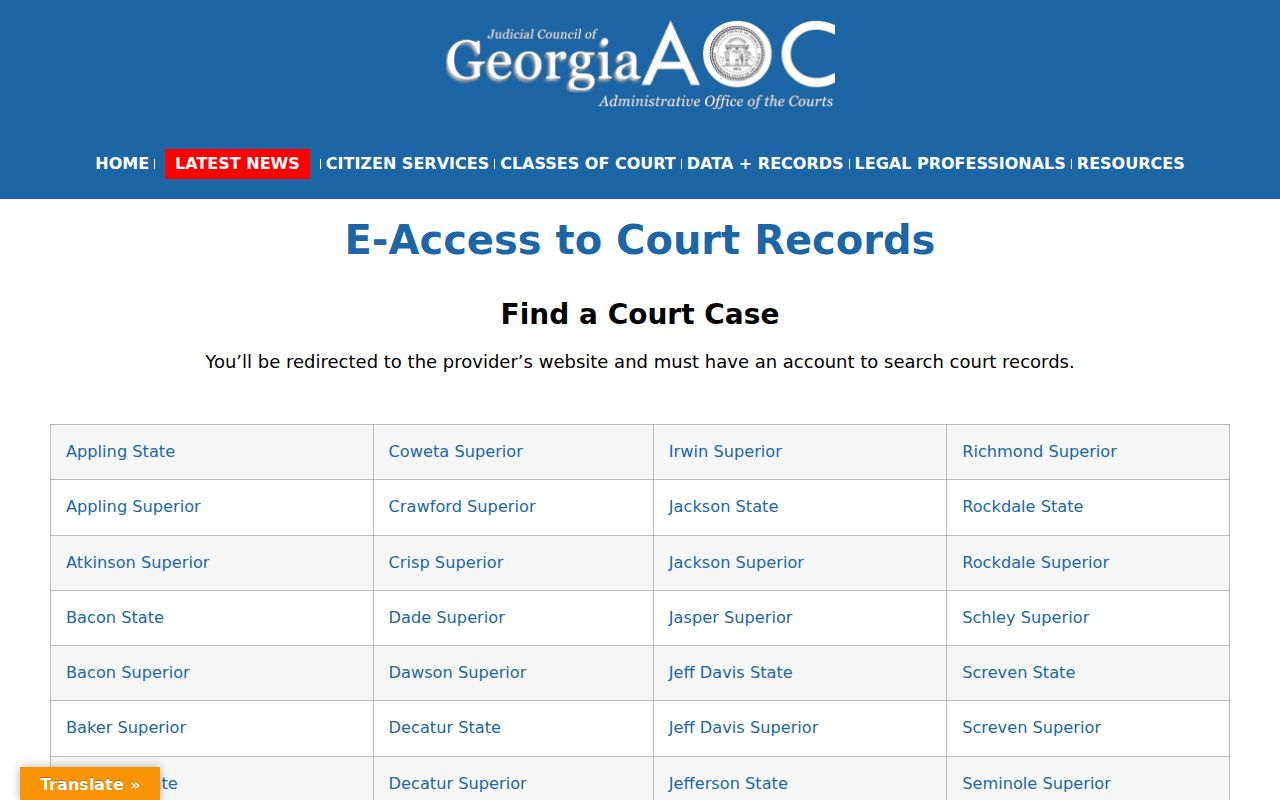
Ask the right clerk division for an older paper or microfilm file. Supply the party spelling, approximate year, and case number if known. Sealed cases, adoption and juvenile matters, protected identifiers, and other restricted material may be absent or redacted.
| Court | People trail | Fallback |
|---|---|---|
| Superior | Civil, divorce, felony, land, judgments | Superior clerk division |
| State | Civil and misdemeanor dockets | State clerk division |
| Probate | Estates, heirs, fiduciaries, marriage | Probate counter |
| Recorder's | Local ordinance and traffic matters | Local court clerk |
Muscogee Heirs Leave Record Trails
Probate files, obituaries, and deeds can work together when the goal is to identify relatives or locate an heir. Muscogee Probate Court keeps estates, wills, and guardianship files. A petition may name a decedent, heirs, a personal representative, counsel, property, and notice recipients. Recorded deeds can show how land later vested, while legal notices and obituaries add dates, kinship terms, and prior places.
Start with the probate case because it fixes the court, date, and legal names. Check each named person against the deed index and the library's obituary sources. Do not assume that everyone named in an estate lived in Muscogee County. Mailing addresses may point elsewhere, and the exact role matters. A personal representative manages the estate; that role does not by itself make the person an heir or owner.
Use records lawfully. Do not use an address, family link, court entry, or registry result to stalk, threaten, harass, or harm anyone.
Muscogee Vital Record Paths
Certified birth and death copies come through the Columbus Health Department or Georgia Department of Public Health. Birth certificates are restricted to eligible requesters. Death certificates are generally available, but a version showing cause of death is limited to eligible family members and legal representatives. Request forms call for the name, event date and place, applicant identity, relationship, signature, acceptable identification, and payment.
Marriage and divorce follow different paths. Muscogee Probate Court issues marriage-license copies, while Superior Court keeps divorce cases and decrees. State verification is not the same as the signed county instrument. Georgia's statewide civil registration began in 1919, but Columbus began birth registration in August 1890. That local head start makes the library's indexes vital for family history.
Search Columbus Before State Registration
Chattahoochee Valley Libraries bridges many gaps left by online government systems. Its Genealogy and Local History Department holds city directories, censuses, maps, military sources, newspapers, court material, biographical works, and local files. Select name indexes are online, while more material requires an on-site visit or a question to staff at 706-243-2681 or CVL-Genealogy@cvlga.org.
The local series are unusually precise. The Muscogee marriage index covers 1835 through 1929. Columbus birth indexes and registers cover August 1890 through 1918. Death sources include a register through 1899 and an Enquirer-Sun index from 1900 through 1918. A Ledger-Enquirer obituary index covers 2006 through 2011. These are index leads, not certified records, but they can supply the name, date, and source needed for the next request.
Use adjacent sources to test a match. A marriage entry may supply a prior surname, an obituary may identify relatives, and a directory may place the household on a street. Cemetery records for Linwood, Porterdale, East Porterdale, and Riverdale can add dates, kin, military service, lot ownership, or affiliations. Confirm a transcription against the cemetery office record when accuracy matters.
Muscogee Directory Address Trails
Columbus city directories can move a search backward from an old address or forward from a surname. Entries may list residents, occupations, employers, spouses, widow status, and street addresses. Later street or reverse sections can turn an address into an occupant, though the library has not published a complete year-by-year list of which books include those sections.
Confirmed digitized editions include 1859-60, 1873, August 1878, 1884, 1888, 1891-92, 1894, 1916, 1921, 1950, and 1951. The run is not continuous. Digital Library of Georgia text can contain uncorrected optical character recognition, so search several spellings and inspect the scanned page. The 1894 John H. Zorn directory is a local quirk: it includes county landowners alongside civic and business listings for Columbus and Phenix City.
Muscogee Custody and Registry Checks
Current custody and supervision records require care. The Muscogee County Sheriff's Office supplies jail information, and its jail number is 706-653-4258 when the online route is unavailable. Georgia Department of Corrections Find an Offender searches by GDC ID, case number, name, gender, race, and age range. Results may include identity, status, facility, offense, sentence, and release or parole facts where public.
The official state offender form shows the available search controls.
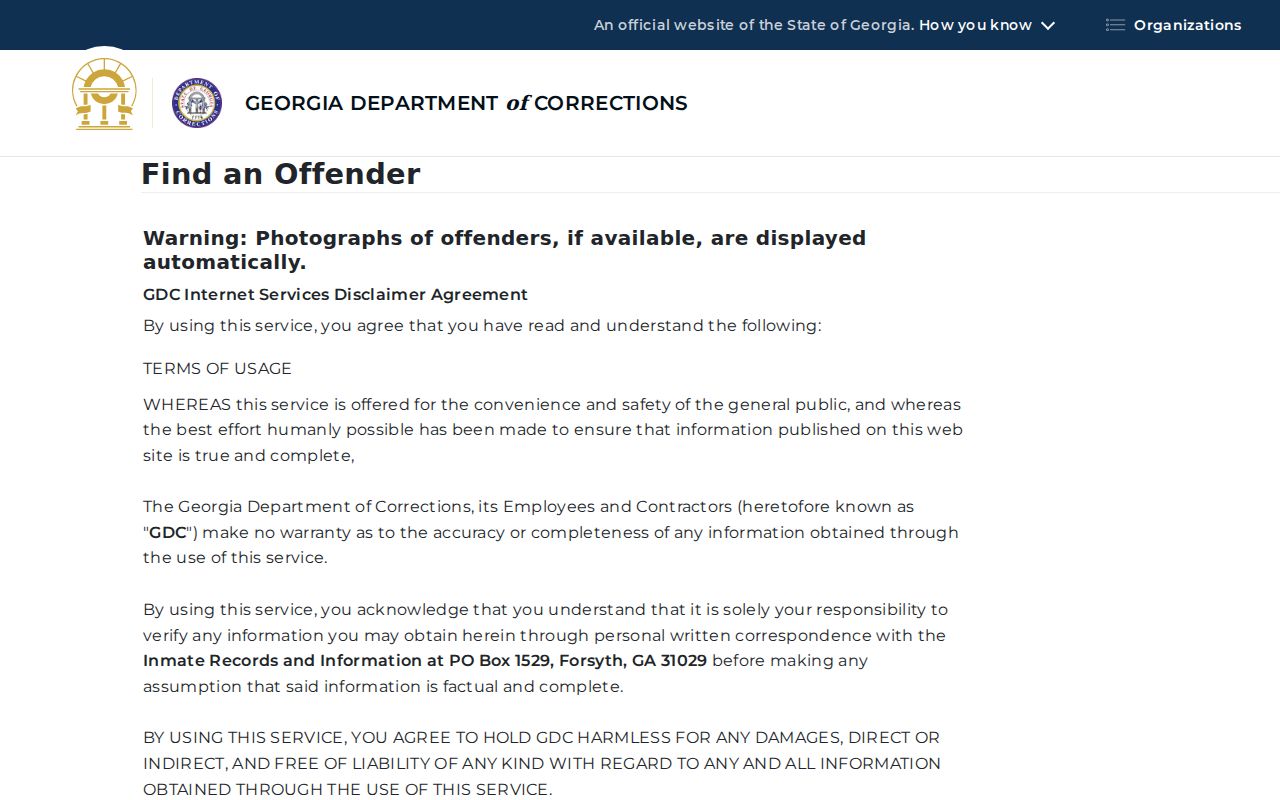
A booking or charge is not proof of a conviction. Match the person carefully and check the final court disposition. The GBI registry is an official safety resource, but its entries must never be used to threaten, intimidate, or harass.
Muscogee Business Name Connections
Georgia's Corporations Division business search connects entities to officers, registered agents, filing addresses, and filed documents. A local trade name, often called a DBA, is filed through the Superior Court clerk. Search the entity name first, then compare the officer or agent with a deed, license, or court record. A registered agent is a service contact and should not be treated as the owner without more evidence.
Professional sources add a second check. Georgia Secretary of State verification covers many regulated occupations, while separate official directories serve physicians, attorneys, and real estate licensees. A public certification can show name, credential number and type, original date, expiration, status, address of record, licensing authority, and public discipline. A current status is stronger than a stale directory listing.
When Muscogee Portals Fall Short
Online access is only one channel. The real estate clerk accepts counter and mail copy requests. Court divisions can locate archived files when given names, an approximate year, and a case number. Police records may be requested online, by email, mail, fax, or at the counter. The sheriff accepts requests by email, mail, or in person. General consolidated-government records can go to the City Attorney, though the department custodian remains the best first choice.
Georgia's Open Records Act requires a response within three business days. The agency may produce the record, give a timeline and cost estimate, or cite the legal basis for withholding. That deadline is not a promise that every file will arrive in three days. Narrow requests by date, office, person, address, incident number, case number, and desired format. Ask for segregable portions when part of a record is exempt.
Official source
Names the custodian, date, status, and record context. It may require more than one portal or a direct copy request.
Commercial compilation
May merge old or mismatched data. Use it only as a lead and confirm each fact with the office that created the record.
Muscogee Records Cross Old Borders
Muscogee County was established in 1825, and Columbus became its seat soon after. The original county covered a far larger area. Parts later went to Harris, Marion, Talbot, and Chattahoochee counties. A family that seems to vanish may not have moved at all; the record custodian may have changed as a boundary shifted.
Another dividing line came with the 1971 consolidation of Columbus and Muscogee County. The Clerk of Council now holds both city and county material, yet older administrative series began under separate governments. Its holdings reach 1819 and include voter, tax, court, cemetery, treasury, and council material, plus an 1864-65 hospital register for sick and wounded soldiers. The Georgia Archives also warns that less than ten percent of its holdings are online. Its Muscogee example, an 1844-45 Superior Court divorce trial in Minutes Book C, shows why a failed web search should lead to catalogs, staff, microfilm, and original books rather than a dead end.
Institutional collections add names that never reach a modern portal. Columbus State University Archives and Special Collections reports about 500 manuscript collections and more than 700 interviews in its general oral-history collection. The Mill Worker Oral History Collection has 41 cassettes and 29 transcripts gathered in 1988. Those accounts connect residents with Bibb, Swift, Muscogee, Eagle & Phenix, and other mills, as well as neighborhoods, migration, wartime life, and family ties.